As word of the great transformation spread across the world, new masters
arose and left their own marks. From Sri Lanka, across Normandy and
Scotland, even into the lands of Syria and Israel we find footprints
left in solid stone, where local folklore has not always attributed
these signs to ascended masters. David Wilcock reveals the worldwide
impressions that Dzogchen masters have made as they spread their quest
for transformation around the world in this presentation originally
webcast July 28, 2014. - See more at: http://www.gaiamtv.com/video/72-worldwide-footprints-masters#sthash.Tx7JhEz2.dpuf
A
footprint believed to be St. Patrick's, impressed into local
stone, may be seen in the field to the rear of the graveyard.
The Chapel of the Ascension
is a mosque where Jesus ascended to heaven forty days after his
resurrection. Inside of the mosque, there is a stone which has the
footprint of Jesus from where he last stood. The Christian church has
two services every year because of the The Gregorian and the Julian calendars.
Original name for Jesus
The English name Jesus derives from the Late Latin name Iesus, which transliterates the Koine Greek name ἸησοῦςIēsoûs.
In the Septuagint and other Greek-language Jewish texts, such as the writings of Josephus and Philo of Alexandria, ἸησοῦςIēsoûs is the standard Koine Greek form used to translate both of the Hebrew names: Yehoshua and Yeshua.
This page provides the best direct and supporting evidence for the reality of the rainbow body phenomenon, i.e., paranormal feats associated with the practitioners.Information on how to engagein the practices is also included.The phenomenon, as you will see, has continued to happen right up into modern times. Many additional links beyond those of the original
authors have been added throughout the text to better explain and
back-up claims made.
"This is one of the mysteries the Institute of Noetic Sciences paid to investigate. They wanted to find out what the heck is going on here. Is this real? Because they read books that I was reading that talked about this. And the amazing part is, that between China and India (China being Tibet basically) there are 160,000 documented cases of people going through this process. And they have left behind an impressive wealth of visible physical evidence that something remarkable did happen to them. In other words, it's not just that there's documentation that people in the West will pooh-pooh. Even though we have a witness from the Western world, Father Tiso, people are gonna pooh-pooh that too. Even though the Chinese military witnessed it. They're gonna pooh-pooh that. But there is something real going on here with this mystery of the rainbow body." - David Wilcock, Introduction to the Mysteries of Tibet
“Then the righteous will shine like the sun in the kingdom of their Father.” – Mathew, 13.43:
Stories of luminosity or saintly radiance are common among Christian
saints, Sufis, Taoist sages, Hindu yogis, Buddhist mystics and
indigenous shamans. Many are historically documented, not metaphor. I am
talking about actually radiating light, about radiance emanating from
the physical body like light from a light bulb, to extreme cases of
becoming a translucent bubble of light. The ultimate Great Completion
culmination is the Rainbow or Body of Light attainment. This is widely
recognized as a sign of extreme sanctity in Tibetan Buddhism and among
the Bönpo. Reports of this level of transmutation are rare, but still
they occur and have been chronicled far into antiquity. Interestingly
the Bön lays historical claim to a lineage of Dzogchen that pre-dates
the entry of Buddhism into Tibet. Rainbow or Body of Light attainment is
not limited to Buddhism, as I started out by saying stories of
luminosity abound in all the great religions of the planet, but to
understand the process we turn to the rationalist Buddhist of Tibet and
the well documented and delineated practice of Dzogpa Chenpo or simply
Dzogchen.
In the Himalayan regions, the early indigenous religion was that of
the Bön. Bön pre-existed the creation of both the sovereign territories,
later to become the country of Tibet as well as of Buddhism. When the
great Indian tantric sage Padmasambhava brought Buddhism from India to
Tibet in the 8th Century AD he found the richly tilled ground of the
Bönpo. This land and its peoples took easily to the Buddha’s teachings
and the Buddhist beliefs melded well with the rituals of the Bön.
When Padmasambhava left at the end of his time in physical form he
dissolved his body completely back to their natural elements leaving no
relics behind. At that moment a new lineage of Buddhist teachings was
created. This was the start of what has become the Nyingma tradition and
is the foundation of Tibetan Buddhism as we have come to know it.
At the heart of the Nyingma tradition is the practice of Dzogchen.
Nyingma alludes to an ancient school, but this is simply because it is
the oldest of the four schools of Tibetan Buddhism (Nyingma, Kagyu,
Sakya, and Gelugpa). The Nyingma teachings are uniquely categorized in
nine yanas, or vehicles. The main practices are emphasized in the three
inner tantras of Maha Yoga, Anu Yoga, and Ati Yoga. Ati Yoga is also
known as the Great Perfection, Dzogpa Chenpo, or simply as Dzog chen or
Dzogchen. Dzogchen practitioners who have attained ultimate insight
(wisdom) and compassion, a phase in which pure and total presence is
stabilized (Trek-chod), are then allowed to practice To-gal.
The Dzogchen symbol 'ah' is ringed by a RainbowTigle
The way I see it, Jesus or Yeshua if you rather, was a rainbow body monk. Just as students go to these monks today for teachings and blessings and just as Padmasambhava is said to have been able to take on someone else's karma to help burn it off, I believe Jesus offers much the same. I have no issue believing that Jesus was an immanation of the divine offering a shortcut to the rainbow body. I suggest trying your best and praying for his help!
“Concerning matter, we have been all wrong. What we have called
matter is energy, whose vibration has been so lowered as to be
perceptible to the senses. There is no matter.”
―
Albert Einstein
Self-arisen Image of the Dzogchen Symbol, Asura Cave in Nepal.
David Wilcock notes on an episode of his program Wisdom Teachings entitled "Science and the Mysteries of Tibet," that the above image (enhanced in the second shot) is a self-arisen image of the Dzogchen symbol. Padmasambhava, AKA Guru Rinpoche, is said to have used mind over matter to imprint the image in stone inside the Asura Cave in Nepal.
In the same program Wilcock explains that the below image is, "The hand of Padmassanbhava that melted its way right into the rock... He just mashes his hand right into the rock because he has now achieved command over physical matter, because he is the matter... He can change it right back to it's vibrational state, it's no longer solid."
David Wilcock states in the video embedded towards the bottom of this page, that the
discoloration inside of the hand print, is due to the countless
individuals who have made the pilgrimage to see it over the years and put their hands inside of it, getting grease in it.
As word of the great transformation spread across the world, new masters
arose and left their own marks. From Sri Lanka, across Normandy and
Scotland, even into the lands of Syria and Israel we find footprints
left in solid stone, where local folklore has not always attributed
these signs to ascended masters. David Wilcock reveals the worldwide
impressions that Dzogchen masters have made as they spread their quest
for transformation around the world in this presentation originally
webcast July 28, 2014. - See more at: http://www.gaiamtv.com/video/72-worldwide-footprints-masters#sthash.Tx7JhEz2.dpuf
During performance of Great
Accomplishment Practices with Drikung Ontrul Rinpoche, inconceivable
accomplishments include the boiling of the contents of the Pantza and
Rakta, multiplying of the nectar pills, flowing forth of nectar from the
Torma and many other such holy accomplishments are witnessed by all. Signs of Ganor Rinpoche's attainment: 1. Rinpoche discovered the
water treasure stone from the Brahmaputra river where the oil comes out
automatically from this treasure stone. 2. Rinpoche left a foot print while conducting the rituals of Chöd and 100-fold changbu. 3. Rinpoche rolled a knife, starting from its tip, between his palms during a group recitation. 4. Rinpoche left a thumb print on a pebble on July 6 1983. 5. Rinpoche revealed the Vajra Kilaya Terma. 6. Rinpoche revealed Terma of The Very Wrathful Achi Chökyi Drolma.
Termas are explained in detail near the halfway point of this page.
Padmasambhava's Footprint at Tso Pema (Wyl.mtsho pad+ma) 'Lotus Lake' in Rewalsar, India, where Guru Rinpoche performed the miracle of transforming the funeral pyre into a lake, after the King of Zahor attempted to burn him and Princess Mandarava alive.
In the Wisdom Teachings episode "Footprints of the Masters," Wilcock demonstrates that while the most impressive, this is but one of several footprints left by Padmasambhava.
He explains that it was made in front of witnesses, painted gold
afterwards, and is accompanied by a self-arisen image to the right.
Self-Appeared Image of the Tara
During the last 35 years people around Pharping in the southern part of
the Kathmandu Valley have noticed that an area of a cliff began to
slowly bulge out. It began to look more and more like Tara, the female
buddha. At the same time the form of Ganesh also appeared. The place is
just below the Asura Cave, sacred to followers of Padmasambhava.
I have seen it many times over the years, and can attest that it has gradually become more distinct.
The following is from the site of the Kunzang Palchen Ling Tibetan Buddhist Center:
Story of the Self-Arising Guru Rinpoche Image
[This was shared by Bardor Tulku Rinpoche at the conclusion of his October 4-5, 2014 teachings.]
This is the story of how that image appeared […] When we were
offering the daranis to — I mean, we say filling the statues — of the 25
disciples of Guru Rinpoche, at that time, I composed three
supplications: a supplication to Guru Rinpoche; a supplication to the
eight forms of Guru Rinpoche; and a supplication to each of his 25
disciples as well as a feast practice, all to be added to the Concise
Daily Practice of the Combined Sadhana of the Vidyadhara Guru, in other
words, the Daily Guru Rinpoche practice.
And having done so, then, we first recited this at the reopening of
the practice site that’s called Chodrak Peak. And the peak of Chodrak,
which is above Chodrak Monastery, was the place where a previous life of
Terchen Barway Dorje, called the Dharma Lord Sonam Zangpo, had spent
most of his life practicing in isolated retreat. He had created that
site along with his master Langray Drakpa Gyaltsen.
Now, the retreat facility or hermitage that was built there was
largely destroyed during the Cultural Revolution, but part of it, couple
of its walls, are still standing. And when we performed this feast
practice there, subsequently, this image of Guru Rinpoche began to
spontaneously emerge from that wall.
To-gal is the final practice of Dzogchen. This final practice enables
the master yogi or yogini to dissolve his or her physical body into the
essence of the elements at the time of death. The master disappears
into a body of light becoming the wisdom body, the term is called
‘Ja’-lus or The Rainbow Body, in Tibetan. It has other names in other
mystical traditions. This level of attainment is also the central aim of
Indian Buddhist tantricism known as Vajrayana that the Taoists call the
golden body. Another term is Soruba Samidhi, the golden body, a state
of God-realization in which Divinity descends and transforms the
spiritual, intellectual, mental, vital and physical bodies. It is
considered physical immortality or the highest perfection.
The final process of dissolution of the body happens over varying
amounts of time ranging from a short period to many days. During this
process the body shrinks dramatically eventually down to only bits of
hair, toe-finger nails, and possible nasal septum left behind. Some
saints such as the great Milarepa (1050-1123) and Padmasambhava
dissolved entirely into light, leaving no relics behind at all...
Often masters that attain the Body of Light will return one last time
out of compassion for their beloved disciples and give what are known as
posthumous teachings, delivered in the form of a last testament. Often
the master is in the transfigured state on occasion suspended in the
sky.
Wisdom
Teachings with David Wilcock: [#69] Science and the Mysteries of Tibet
(July 2014 - See more at:
http://www.gaiamtv.com/video/69-science-and-mysteries-tibet#sthash.ob67eACg.dpuf
Thogal – Translates as “direct crossing” or “leap over”.
It comprises of the final stage practice in Dzogchen in order to ‘attain’ the Body of Light, although in actual fact it is ones true body and one is merely dissolving that which obscures it.
In short, it mostly involves literally integrating the universe ‘out there’ with ones consciousness. Realizing that it is all made up of dancing light and that it is in fact your very self, one eventually (re)turns into light, able to take on any form at any time and go anywhere.
The ultimate fruition of the thodgal practices is a body of pure light, called a rainbow body (Wylie 'ja' lus, pronounced Jalü.)[5]
If the four visions of thogal are not completed before death, then at
death, from the point of view of an external observer, the following
happens: the corpse does not start to decompose, but starts to shrink
until it disappears. Usually fingernails, toenails and hair are left
behind[6] (see e.g. Togden Urgyen Tendzin, Ayu Khandro, Changchub Dorje.) The attainment of the rainbow body is typically accompanied by the appearance of lights and rainbows.[5]
Composed by His Eminence Dzogchen Khenpo Choga Rinpoche and his
disciples on the 23rd of November, 2013, the auspicious day of Lha Bab
Duchen, the Buddha’s Mother’s Day, at the auspicious place of the
Dzogchen Retreat Center, USA.
Dear Students,
As you know from my recent message, my precious teacher Dzogchen Lama
Karma Rinpoche passed away on the 11th of November, 2013. Yesterday I
received extraordinary news from my Dharma friends in the holy Dzogchen
area of Tibet that the sacred body of my kind teacher Lama Karma has
obviously and dramatically shrunk in size. Lama Karma’s body was about
175cm (approx. 5’9”) tall, but two weeks after he passed away, his
seated body has now shrunk to about 20cm (approx. 8”), which means his
body, including his skeleton, shrank nearly 80%. According to Dzogchen
tantra, this kind of miraculous display shows he has attained the Small
Rainbow Body, which is a sign that he has attained the supreme
accomplishment of Buddha in this very life. Please deeply rejoice in his
devoted practice and realization of Dzogchen. In doing so, you
accumulate immeasurable merit.
At age of 84, Lama Achuk entered into paranirvana and achieved the
rainbow body, a great inspiration to disciples to persevere in their
practice of the Great Perfection teachings.29
August 2011, the cremation ceremony of Lama Achuk commenced. The body
of Lama Achuk shrunk from a height of 1.8 meters shrunk to about 1 inch
tall, a sign of achieving the rainbow body
From time of Lama Achuk’s paranirvana to the cremation, many
auspicious signs appear, five colored rainbows are often sighted in the
sky and the area surrounding Lama Achuk’s body often appears five
colored pure lights bindu.
More than 100,000 sangha members and lay devotees attended the puja
and paid respect to the sacred body of Lama Achuk, it was a spectacular
sight to behold.
For those who are incredulent about the possible high and
unbelievable achievements of the dharma especially the Dzogchen
teachings may refer to the unadulterated photos above. Top shows Achuk
Lama Rinpoche in puja, at his forehead is the self manifesting image of
Chenrezig. Bottom Left shows Achuk Lama Rinpoche with Samantabhadra
above his crown. Bottom Right shows Achuk Lama Rinpoche who manifested
the rainbow body in photograph (by the way, the lotus at the bottom is
not there when they took the photo, in case you are wondering… generally
lamas are not put on a lotus, they are put on thrones). You may click
to enlarge…
Achuk Lama Rinpoche is widely acknowledged to be the emanation of
Longsal Nyingpo, Longchen Rabjam, Padmasambhava’s disciple Gyalwa
Choyang, and various other great masters. He has displayed many signs of miracles such as freely leaving hand-prints, foot-prints, discovering
termas, going into the water for days without harm, knowing the past,
present, and future without any impediment, and most popularly for his
body mandala and many thousands of people have witnessed the many
deities and mandalas of the major tantras present in his body itself.
Seeing his body mandala is a unique means of blessing, empowerment and
also a way to ascertain the disciple’s realisation. For some karmically
ready people, it is also an introduction to wisdom mind.
I post this photo for two reasons despite my many hesitations…
1. The photo proves that accomplishments are present in this day.
Many of Rinpoche’s disciples in China have attained accomplishment,
including layperson disciples.
2. The photo of an accomplished being brings blessings by sight.
Achuk Lama Rinpoche is widely acknowledged to be thong-drol which means
liberation by sight.
Tradition holds that terma may be a physical object such as a text or ritual implement that is buried in the ground (or earth), hidden in a rock or crystal, secreted in a herb, or a tree, hidden in a lake (or water), or hidden in the sky (space).
Though a literal understanding of terma is "hidden treasure", and
sometimes objects are hidden away, the teachings associated should be
understood as being 'concealed within the mind of the guru', that is,
the true place of concealment is in the tertön's mindstream. If the concealed or encoded teaching or object is a text, it is often written in dakini script: a non-human type of code or writing.
"Termas are very interesting, because one of the things that these monks would do throughout the next 1,200 years is they would download the Termas. They would channel the original texts, without having any documents in front of them and they were tested based on how accurately they could transcribe the original and they would fail the test if they didn't get every single word exactly correct. Now these scriptures in some cases would be hidden away in far off Monasteriesthat nobody had visited in a long time and then after they had channeled the Terma, they would go back to the Monastery where the original copy was stored and then compare the two" - Wisdom Teachings with David Wilcock: [#71] The Path of Padmasambhava - See more at: http://www.gaiamtv.com/video/71-path-padmasambhava#sthash.kIBO4hnZ.dpuf
"Some of the Termas included material that was embeded in rocks and converted skeptics because they didn't believe in any of this stuff and then the master would say well then break open that rock over there and then they would and there would be an object in it just like he described. So this ultimately knocked down people's denial and helped them on this rainbow body quest." - Wisdom Teachings with David Wilcock: [#70] Footprints of the Masters (July 2014) - See more at: http://www.gaiamtv.com/video/70-footprints-masters#play/53021
Wisdom
Teachings with David Wilcock: [#70] Footprints of the Masters (July
2014) - See more at:
http://www.gaiamtv.com/video/70-footprints-masters#play/53021
When Dudjom Rinpoche (bdud ’joms rin po che)... was sitting
in small room facing the entrance of Padmasambhava’s cave on the cliff
of Paro Taksang (pa ro stag tshang) in Bhutan, the yellow scroll for his
Vajrakilaya cycle of teachings came floating in the air through a small
open window and landed in his lap. In some other cases, tertons are
said to have toiled for days with axes and rods to reach the terma
deeply embedded in the rock.
Wisdom
Teachings with David Wilcock: [#71] The Path of Padmasambhava - See
more at:
http://www.gaiamtv.com/video/71-path-padmasambhava#sthash.kIBO4hnZ.dpuf
Wisdom
Teachings with David Wilcock: [#71] The Path of Padmasambhava - See
more at:
http://www.gaiamtv.com/video/71-path-padmasambhava#sthash.kIBO4hnZ.dpuf
Through his Swiss contact, Tiso received the name of the monk whose body had vanished after his death: Khenpo A-chos, a Gelugpa monk from Kham, Tibet, who died in 1998. Tiso was able to locate the village, situated in a remote area where Khenpo A-chos had his hermitage. He then went to the village and conducted taped interviews with eyewitnesses to Khenpo A-chos’ death. He also spoke to many people who had known him.
“This was a very interesting man, aside from the way he died,” observes Tiso. “Everyone mentioned his faithfulness to his vows, his purity of life, and how he often spoke of the importance of cultivating compassion. He had the ability to teach even the roughest and toughest of types how to be a little gentler, a little more mindful. To be in the man’s presence changed people.”
Tiso interviewed Lama Norta, a nephew of Khenpo Achos; Lama Sonam Gyamtso, a young disciple; and Lama A-chos, a dharma friend of the late Khenpo A-chos. They described the following:
A few days before Khenpo A-chos died, a rainbow appeared directly above his hut. After he died, there were dozens of rainbows in the sky. Khenpo A-chos died lying on his right side. He wasn’t sick; there appeared to be nothing wrong with him, and he was reciting the mantra OM MANI PADME HUM over and over. According to the eyewitnesses, after his breath stopped his flesh became kind of pinkish. One person said it turned brilliant white. All said it started to shine.
Lama A-chos suggested wrapping his friend’s body in a yellow robe, the type all Gelug monks wear. As the days passed, they maintained they could see, through the robe, that his bones and his body were shrinking. They also heard beautiful, mysterious music coming from the sky, and they smelled perfume.
After seven days, they removed the yellow cloth, and no body remained. Lama Norta and a few other individuals claimed that after his death Khenpo A-chos appeared to them in visions and dreams.
Other Rainbow Body Manifestations
Francis Tiso remarks that one of is most intriguing interviews was with Lama A-chos. He told Tiso that when he died he too would manifest the rainbow body. “He showed us two photographs taken of him in the dark, and in these photographs his body radiated rays of light.”
Because Lama A-chos emphasized that it was possible to manifest the rainbow body while still alive, not just in death, Tiso plans to return to Tibet with professional camera equipment to try to photograph this radiating light.
Other incidents of metanormal occurrences upon death are also being studied. For instance, several of Tiso’s colleagues were present for the postmortem process of Dilgo Khyentse Rinpoche, who died eight years ago. “This man was a very large-boned individual,” says Tiso, “and it was reported that seven weeks after his death the flesh was reduced. That could have been done by chemical substances, however, the bones also shrank.”
Shrinkage of the body occurred with another guru, Lama Thubten. His miniature-sized frame is now kept in a monastery in Manali, India. Tiso has ascertained that incidents of bodies shrinking or disappearing shortly after death were documented centuries ago, such as in the classic story of Milarepa, a Buddhist saint from Tibet who lived in the 11th century. Milarepa’s biography was translated into French by Jacques Bacot in 1912, and into English by Walter Evans-Wentz in the 1920s.
“In the ninth chapter of this literary classic,” explains Tiso, who wrote a dissertation about the Buddhist saint, “It states that his body completely disappeared shortly after his death.”
Even the earliest biographies of Milarepa, says Tiso, attest to this phenomenon. In addition, accounts exist about the great eighth-century tantric master Padmasambhava and how his body vanished.
The Significance of Practice and Culture
When conducting this type of research, says Tiso, it is important not only to interview as many people as possible, but also to study biographies and any written explanations of these events. When he arrived in Tibet to investigate the death of Khenpo A-chos, Tiso was fortunate enough to obtain the bulk of his biography by Sonam Phuntsok within an hour of his arrival.
What is at stake, explains Tiso, is not simply verification of a phenomenon, but understanding the values, spiritual practices, and culture in which this phenomenon is embedded. “We need to examine these institutions and practices in a new light in order to recover for humanity some very profound truths about the expansion of the human consciousness and our potential as human beings.”...
Lama A-chos told Tiso that it takes sixty years of intensive practice to achieve the rainbow body. “Whether it always takes that long, I don’t know,” acknowledges Tiso, “but we would like to be able to incorporate, in a respectful way, some of these practices into our own Western philosophical and religious traditions.”
At the same time, continues Tiso, the research team plans to expend the scope of this research beyond the confines of the Tibetan culture, so they can compare the rainbow body phenomenon with the resurrection of Jesus Christ. To our knowledge, says Tiso, the bodies of most Christian saints did not disappear or shrink after their deaths.
“Highly realized saints in Catholic and Orthodox Christianity tend to move in the direction of incorruption, so that the body does not decay after death.”
However, he adds, bodily ascensions are mentioned in the Bible and other traditional texts for Enoch, Mary, Elijah, and possibly Moses. And there are numerous stories of saints materializing after their death, similar to the widespread phenomenon known as the “light-body.”
“In my church of Saints Cosmas and Damian in Italy, we have a large number of accounts, going back centuries, that indicate that these saints appeared in dreams and visions, rescued people from harm, and cured them of diseases. Even today, people still tell me they have these visions,” says Tiso.
In 1984, when Tiso was meditating with his eyes open in a chapel in Italy, he, too, had an extraordinary vision. Jesus Christ, he says, appeared before him in the form of a violet light-body. At that time, Tiso was considering taking a teaching position in the United States, but in this vision Christ indicated he should stay in Italy. “It was important not to make a mistake at that point in my life,” reflects Tiso. “I did stay in Italy, where I was eventually ordained, and I lived in a hermitage chapel for almost twelve years.”
Tiso has also had several Tibetan teachers appear to him in dreams. When he gives public lectures he speaks frankly about these experiences, because he feels it is important for people to understand that they are more common than we think. “I think that as people mature in their spiritual practice, they begin to have visionary experiences.”
Rangjung Rigpe Dorje (August 14, 1924 – November 5, 1981)
During the seven weeks between his death and his cremation, the
Karmapa's body spontaneously shrank to the size of a small child. He was
cremated in Rumtek. His two dogs died on the day of his cremation even
though they were healthy.[9] During the cremation a triple circular rainbow appeared above the monastery in a clear blue sky.[6] Many photographs exist of this remarkable phenomenon[where?]. While his body burnt, an object rolled from the flames to the Lopon Tsechu. This object was quickly recovered and proved to be the Karmapa's eyes, tongue and heart.[citation needed] This was taken[by whom?]
to indicate that the body, speech and mind have come together to be
saved as relics for the future and is common in only the highest of
accomplished Buddhist yogis - exactly the same thing is said to have
occurred during the cremation of Gampopa and the Second Karmapa, Karma Pakshi.[10]
Rangjung Rigpe Dorje - The beginning stages of the rainbow body - see past incarnations
(This is not a case of motion blur or long exposure as can be
clearly seen with the nose that has no history line of motion and the
whole body which is blur without a direction of motion on the clear
background. Also keep in mind that this picture was taken in the late
70's so no digital camera tricks or computer tricks are at work.)
"This is not photoshopped. People witnessed this in the room. He literally faded his physical body away." - David Wilcock
Rainbow Body: The Life and Realization of a Tibetan Yogin, Togden Ugyen Tendzin, presents
the remarkable life story of Togden Ugyen Tendzin (1888–1962), a
Tibetan yogin who in death achieved the “rainbow body,” the release of
the physical body in the essence of the five elements and one of the
highest spiritual attainments of Dzogchen, recognized as the supreme
level of Tibetan Buddhism. His nephew, Chögyal Namkhai Norbu, one of the
greatest living masters of Dzogchen, composed the book from his own
recollections of his uncle as well as direct quotes from talks with the
great yogin himself and his disciple Sala Karma Samten. The book traces
the yogin’s childhood struggles, the circumstances that led him to his
teacher, the eminent Adzom Drugpa, and his difficult path to
self-realization. Finally, Chögyal Namkhai Norbu relates the story of
Ugyen Tendzin’s death during imprisonment by the Chinese, when witnesses
discovered that though his sheepskin robe still sat upright, his body
was gone—a testament to its having dissolved into the rainbow body.
Excepts:
Showing Miraculous Powers
One day, lightning struck Kamge Nyendrag, a monk from Rabten who was with Ugen Tendzin at that time, and it almost killed him. Immediately, Togden wrapped the lightning bolt in his robe and hurled it far away... Another time, when a hunter was shooting at wild animals, Togden cried out, "Ouch! Ouch!" and the bullet veered toward him instead...
They looked inside the sheepskin robe and saw Togden's dead body sitting up straight, the size of a three- or four-year-old child... Tresdön clearly understood that Togden Rinpoche was in the process of realizing the rainbow body, but he did not say anything to his assistant. They immediately went back to the local district office and related in detail to the officers what had happened. "How could something like this happen?" a Chinese officer who was present burst out. But nobody replied.
End of excepts.
Nyala Rinpoche Rigdzin Changchub Dorje (1826 – 1961/1978) was a teacher of Dzogchen, terton and practitioner of Tibetan medicine...
Flying Away into the Sky
What
is described below is one popular version of the event that was commonly
known to the elder local people in Tongde County. This version was
known to most people and believed by most people. Our investigation,
witness interviewing, analysis and verification were conducted around
this version.
According to local people, one day in September of 1958, a mass
assembly was to be held near the Digan Temple in Tongde County to
criticize and interrogate Khenchen Tsewang Rigdzin (Khenpo Chaiwan
Runzheng). At that time, he was already in jail in the County Prison.
Several small hills must be crossed from the prison to the site of the
mass assembly. Several soldiers were escorting the Khenpo after taking
him from the prison. Because of his handicap, the Khenpo was allowed to
ride on the back of a red yak. When the group of five or six people were
approaching their destination, an extremely strong and violent
whirlwind (cyclone) suddenly took place. The wind was so strong that
none of the soldiers could open their eyes. Their location at the time
was close to the top of a hill, with a distance of several kilometers
from the Digan Temple. After the wind had gone away, the soldiers
started to look around. However, Khenchen Tsewang Rigdzin (Khenpo
Chaiwan Runzheng) was no longer on the yak. Before starting the trip, to
prevent an accident, the soldiers had tied the Khenpo tightly on the
back of the yak with rope. All their efforts were proven to be in vain,
because the Khenpo had flown into the sky, accompanied by several
auspicious colored clouds. This event was witnessed by many people at
the scene.
3. My Investigation
If you come to Tongde County and mention the name of Khenchen Tsewang
Rigdzin (Khenpo Chaiwan Runzheng) to people, almost anyone will tell
the above story to you in similar details. Even though the story is so
commonly known, I still decided to do my investigation from the start.
My first goal was to clarify the doubt many people may have. On the
other hand, I wanted to have the facts recorded truthfully. I wished to
find out: did people put their feelings into the story so the truth got
covered by kind lies? Also, between legend and fact, to what degree and
scope can the truth be re-manifested?
The people I interviewed in my investigation included some who were
escorting the Khenpo at the time; those who were near the location when
the Khenpo was flying away, including some eye witnesses; and a number
of people who listened to the entire story from eye witnesses. When
putting their words into text, I wrote down exactly what they said
almost without editing a word. My goal was to let the readers draw their
own conclusions naturally, without being influenced by the subjective
and, possibly, already fixed thinking in my mind. I believe that this
style of truthfully presenting the original narration would be
convincing to the readers.
My first interview was with the elderly Zhimei, who is 77 years old now. He was a local shepherd in Tongde County. He told me:
“On the day when Master Tsewang Rigdzin (Chaiwan Runzheng) was taken
from the prison to the site of the mass meeting, I was watching cattle
on one of the hills he must pass. I saw several soldiers passing by with
the Master. They tied the Master onto the back of a red yak. When they
went over the top of the hill, I was with the cattle half way on the
hill. Then, I suddenly saw the Master, in monk’s clothing, started to
ascend from the other side of the hill. At the beginning, he was flying
up slowly. Eventually he disappeared into the clouds. Many people said
that there was a strong swirling wind and auspicious colorful clouds
appeared in the sky but I did not see those scenes. This may be because I
was half way up this side of the hill, while the Master had already
gone to the other side. All I saw was that the Master flew into the sky.
I saw that with my own eyes. I was still young then with good eye
sight. It would be impossible that what I saw was some illusion. Years
later, the charges to those jailed in 1958 were dropped. The Master’s
hometown Hongyuan also sent people to request the Master’s remains from
Tongde County. I knew that they would not get them because the Master
flew away into the sky. I saw that with my own eyes. I told this to my
family members but I dare not to tell the people from Hongyuan. After
all these years, now as an elderly person of almost 80 years old, I am
telling this story again from my memory. Do you think I would fabricate
it to deceive you? I absolutely do not have any false statement in it. I
do not have any reason to lie on this. In general, there are two
possible motives for one to lie. One is trying to reap benefits from
doing so. The other is being forced to lie and under pressure. My
situation has nothing to do with either of these. That’s why I can
guarantee you that I did not make any false statement in what I said.”
The elderly Zhimei was an eye witness of the event. The next person I
met, Chongpeier, provided detailed collaborating materials in many
aspects. Also, he was the most talkative person among those I
interviewed.
Chongpeier is over 60 now. He is a local resident and currently stays
at home after retiring from his job. He was a middle-level cadre of
Tongde County. He described to me, in great detail, what he learned on
this event:
“I remember that it was a day in October of 1988. I was the director
of the Bureau of Industry and Commerce Management of Tongde County then.
On that day, when it was near the end of workday, a Han (mandarin)
person came to see me and invited me to have dinner with him. At the
dinner table, he told me his purpose of looking for me. His name was Li
Desheng and he was from the Shangchun Village of Huangzhong County in
Qihai Province. He came to Tongde County to buy about 500 head of cattle
and lambs from local people. He wanted to ask me a favor of collecting
less taxes and fees from him. He told me that he knew many senior
officials in Tongde County very well, but not me. I asked him where he
had worked before. He said that he has been a soldier in the security
force of Tongde County and had risen to the position of a squad leader.
While we were enjoying wine and dining, he told me a miraculous
experience of his that was beyond imagination:
‘I saw a person who flew away in front of my own eyes. At that time, I
and several soldiers of my squad were escorting that Lama from the
prison to the mass meeting site near the Digan Temple. We tied him
tightly onto the back of a yak and surrounded him as we were on our way.
While we were climbing the hill and close to the top, he started to
chant something that we could not understand. At the top of the hill, we
ordered him to stop making the sound. Then we saw that the other side
of the hill was flat land. Suddenly, many pieces of colored clouds flew
over. The Lama got carried away by the clouds!
Well, it was easy for him to get carried away by the clouds but we
were left with the burden of reporting this event to the upper level.
When I reported this to the county government, I was told that I did not
accomplish my task and I had to write a report to repent myself. I did
write that report of repentance.’
Li Desheng also told me that, after hearing this event, the Attorney
General of the county was a little moved and said, ‘This is really very
strange.’ Just for saying this, the Attorney General was removed from
his position, because the higher level thought he was a superstitious
person. Many people in Tongde County knew about the firing of the
Attorney General from his job but they all speculated that it was due to
some other fault he committed and did not know the real reason. Li
Desheng mentioned that he told his parents about this and they held
their palms together and respectfully said, ‘this person (Khenchen
Tsewang Rigdzin) is great and incredible.’”
Chongpeier added, “Normally he should be charged over 2000 Yuans of
taxes and fees. For telling me this event, I only collected about 700
Yuans from him.”
1-Wherever possible, the names and places
listed here have been translated as they appeared in other
Tibetan-English sources. The transliteration of these names from the
original Chinese article are also provided in parentheses.
2-Other accounts of this story indicate
that Tsewang Rigdzin was a very big man, weighing over 330 pounds at the
time of his leaving this world. It was not uncommon for people from
this area to be over seven feet tall.
3-In another account of this event, it was
reported that after witnessing the lama flying away, several of the
soldiers who had pointed their guns at the lama became devout Buddhist.
Although that article has not been translated yet from the Chinese, I
believe from oral accounts that it was written by one of these soldiers.
This examples given were taken from an article written by the
abbot of Shangdan Temple in Tongde County, Huangnan Region of Qinghai
Province. Before 1958, Shangdan Temple had been the home base of
Khenchen Tsewang Rigdzin (Khenpo Chaiwan Runzheng) for propagating the
dharma and benefiting living beings.
In 1953, apparently having lived to the age of one hundred and fifteen,
Ayu Khandro passed away. For the few weeks before her death she spent
most of her time seeing anyone who wanted to speak to her and gave away
her valuable possessions, such as a precious statue of Padmasambhava
which she gave to Adzom Gyelse Gyurme Dorje
(a 'dzom rgyal sras 'gyur med rdo rje, 1895-1959), the son of Adzom
Drukpa, and a small statue of Jamyang Khyentse, made by his own hand,
which she left for Namkhai Norbu. After her death, it is said she
remained in meditation for two weeks and by the end of the two weeks her
body had shrunk to a fraction of its original size, a sign of her
accomplishment of Dzogchen practice.
It is said that at least once Ayu Khandro had a spontaneous involuntary
experience of long-distance teleportation. After the event she could not
replicate the achievement at will and was forced to travel home for
many days.
Anniversary of Shardza Tashi Gyaltsen Attaining the Rainbow Body
The 13th day of the 4th month on the Tibetan lunar calendar is the
anniversary of the rainbow body of Shardza Tashi Gyaltsen. This year,
that date is June 11th. Shardza Tashi Gyaltsen was a Yungdrung Bön
monk, teacher, scholar and realized practitioner of the modern age. In
1934, he attained the rainbow body, Tibetan jalu, which is a
sign of high realization in the practice of Dzogchen. Essentially, the
practitioner has purified their karma and realized the ultimate state of
mind such that at the moment of death, the five elements which
construct the physical body dissolve into pure light rather than
degrading. In this way, over the course of a few days, the physical
body proportionally shrinks and, in some cases, completely disappears
leaving only the hair and nails.
Hair and nails of Shardza Tashi Gyaltsen that were recovered after his attainment of the rainbow body
Throughout his life, Shardza Tashi Gyalstsen was known for stringent adherence to the many hundreds of vows that he had taken throughout his life. Additionally, he taught a multitude of disciples, organized the reconstruction of temples, went on pilgrimages, and spent a great deal of time in isolated meditational retreats. A prolific writer, he wrote volumes on the subjects of Bön history, instructions and guidance for the practice of Tibetan yoga, and detailed instructions for the advanced practice of inner heat, known as Tummo, among many other subjects.
In 1934 at the age of 76 during an offering ceremony, he began to spontaneously sing songs of realization. A few days later, he sewed himself inside of a tent and forbid any of his disciples to open the tent. The next day, rainbow lights began appearing above and around the tent. After 3 days, the ground shook. By the 4th day, rainbow-colored mist was seen coming through the seams of the tent. On that 4th day, Shardza’s disciple Tsultrim Wangchuk, afraid that his lama’s body would completely disappear and leave nothing for veneration, opened the tent. He found Shardza’s body enveloped in rainbow light, levitating in midair, and shrunken to the proportional size of a 1 year old. The area around the heart was still warm but most of the nails of the hands and feet had fallen onto Shardza’s seat below. For the next 49 days, disciples paid their respect. After that, the precious remains were placed into a reliquary chorten. From time to time, many people have reported seeing clear or rainbow-colored light emanating from this chorten.
Written in verse in the form of invocation, it was composed by Lhundrub Tso (1864-1946)...
To me and other students,
You pointed your index finger skyward in the threatening gesture
And caused the character [Dzogchen symbol 'ah'] white and luminous to appear...
Summoning your beloved student
Togen Ugyen Tendzin,
You predicted in a clear way
That soon you would pass into Nirvana...
[After three weeks]
On the twenty-fifth day of the ninth month...
You... passed into nirvana...
In that moment in the pure space of the sky,
Rainbow clouds ammassed in the form or ceremonial parasols,
While you showered us with a delicate snow
Of white lotus blossoms...
Then you left a body that was the size of an eight-year-old boy...
And when they carried your body to the cremation grounds,
Thunder rolled three times...
And they [hundreds of lamas] all saw clearly
That the sky was filled with rainbows,
That among flames five-colored [Buddhist Hum Symbol] were appearing,
And then even the smoke took the form of [Buddhist Hum Symbol]...
End of excerpt.
Now, with regard to the "Rainbow Body", I have a great book that I
inherited from my grandmother called "A Gift of Prophecy" by Ruth
Montgomery (1965). It's about the psychic Jeane Dixon. In it, there's
an account by a friend of Jeane's, Joan, who was sitting with Jeane in
church as the two were praying together. The following is a quote from
the book: "I had been there several times with Jeane," she (Joan) says
wonderingly, "but on this particular morning I happened to glance toward
her while she was praying, and she wasn't there. This may sound silly,
but the place beside me was absolutely vacant. All I could see was a
soft haze of light and the empty pew. In a moment, of course, she was
back, quietly praying as before. It was a profound experience. I still
don't believe in psychic things, but I believe utterly in Jeane."
At
the time I read this, I had just recently read a post by David Wilcock
entitled, "Reality and Romance" (December 21, 2012). Here's the link to
the article:
http://divinecosmos.com/start-here/davids-blog/1099-2012romancereality .
I suddenly realized that Jeane's temporary transformation into the
"Rainbow Body" was what Joan described in her account and is what David
described in his article.
Arutprakasa Vallalar Chidambaram Ramalingam (5 October 1823 – disappeared on 30 January 1874)
Ramalingar raised the flag of Brotherhood on his one room residence Siddhi Valakam[16]
in Mettukuppam on October 22, 1873. He gave his last and most famous
lecture, entreating his audience to undertake a spiritual quest and look
into the "nature of the powers that lie beyond us and move us," and
asking them to meditate on the lighted lamp from his room, which he
placed outside.
Adigal on January 30, 1874, entered the room and locked himself and
told his followers not to open it. He said that even if they did open it
they would find nothing (United with Nature & ruling the actions of
'all of the alls' - as told in his poem called 'Gnana Sariyai'). His
seclusion spurred many rumors, and the Government finally forced the
doors open in May. The room was empty, with no clues. The Madras
District Gazetteer published by the South Arcot District in 1906 records his disappearance.[17]
Swami Ramalingam attained a Supramental state of deathless triple body; the siddha or
perfected physical (gross) body, the subtle or mantric body, and the
jnana or knowledge body. Finally, he dissolved his outer form (the
equivalent of the Tibetan
"Rainbow Body" in order to enter into universal existence and continue
the work of Supramentalization that was then taken up by Sri Aurobindo
and the Mother.
Most sources state that the teacher in 1872 attained rainbow body.
According to one source, he on purpose did not, but reduced the left
dead body in size and transformed it so that it would not decompose.
According to the source the small body is now hidden at a secret
location.
On the morning of October 25, Tsongkhapa entered into samadhi meditation. He made many inner offerings and stopped his breath. Many saw his body transform back into that of a 16-year-old boy and rainbows emitting from his body. Some even saw dakas and dakinis in the sky, making a lot of offerings to welcome Tsongkhapa back into the Pure Land. He was 63 when he passed away.
In the following presentation David Wilcock contends that Rangjung Rigpe Dorje did not fully achieve the rainbow body, however, this is contradicted by the information on Dorje found above, found just below the third image counting upwards. Wilcock also contends that Padmasambhava was a human extraterrestrial.
The Dzogchen teachings state:
In the north-western part of the land of Oddiyana, on an island in the lake of Dhanakosha,
the blessings of all the buddhas took shape in the form of a
multi-coloured lotus flower. Moved by compassion at the suffering of
sentient beings, the Buddha Amitabha sent out from his heart a golden vajra,
marked with the syllable HRIH, which descended onto the lotus blossom.
It transformed into an exquisitely beautiful eight year old child,
endowed with all the major and minor marks of perfection, and holding a
vajra and a lotus.
The Tibetan Book of the Dead is one of the texts that,
according to legend, Padma-Sambhava was compelled to hide during his
visit to Tibet in the late 8th century. The guru hid his books in
stones, lakes, and pillars because the Tibetans of that day and age were
somehow unprepared for their teachings. Now, in the form of the
ever-popular Tibetan Book of the Dead, these teachings are
constantly being discovered and rediscovered by Western readers of many
different backgrounds--a phenomenon which began in 1927 with Oxford's
first edition of Dr. Evans-Wentz's landmark volume. While it is
traditionally used as a mortuary text, to be read or recited in the
presence of a dead or dying person, this book--which relates the whole
experience of death and rebirth in three intermediate states of
being--was originally understood as a guide not only for the dead but
also for the living. As a contribution to the science of death and
dying--not to mention the belief in life after death, or the belief in
rebirth--The Tibetan Book of the Dead is unique among the sacred texts of the world, for its socio-cultural influence in this regard is without comparison.
This fourth edition features a new foreword, afterword, and suggested further reading list by Donald S. Lopez, author of Prisoners of Shangri-La: Tibetan Buddhism and the West.
Lopez traces the whole history of the late Evans-Wentz's three earlier
editions of this book, fully considering the work of contributors to
previous editions (C. G. Jung among them), the sections that were added
by Evans-Wentz along the way, the questions surrounding the book's
translation, and finally the volume's profound importance in engendering
both popular and academic interest in the religion and culture of
Tibet. Another key theme that Lopez addresses is the changing nature of
this book's audience--from the prewar theosophists to the beat poets to
the hippies to contemporary exponents of the hospice movement--and what
these audiences have found (or sought) in its very old pages.
Fifteen persons with whom I have spoken claim to have recalled the
passage of their soul through the nonphysical worlds. In these cases a
person had a remembrance in which he experienced full participation in
one of his past lives. But instead of his remembrance terminating during
some point within that lifetime, he believes that he reexperienced his
death at the end of that lifetime, he believes that he reexperienced his
death at the end of that past life, the passage of his soul through the
higher worlds after his death, and his rebirth in his next incarnation.
In each of these cases of between-life remembrance, people experienced
similar phenomena to note that although none of these cases persons were
familiar with the Book of the Dead prior to their remembrance,
their descriptions of both the order and nature of their experiences are
strikingly similar to the descriptions of death and rebirth process
found in the Tibetan Book of the Dead.
The
consciousness of the departed has an ecstatic experience of the primary
"clear light" at the death moment. Everyone gets at least a fleeting
glimpse of the light. The more spiritually developed see it longer, and
are able to go beyond it to a higher level of reality. The average
person, however, drops into the lessor state of the secondary "clear
light."
In stage two, the departed encounters the
hallucinations resulting from the karma created during life. Unless
highly developed, the individual will feel that she is still the body.
The departed then encounters various apparitions, the "peaceful" and
"wrathful" deities, that are actually personifications of human feelings
and that, to successfully achieve nirvana, the deceased must encounter
unflinchingly. Only the most evolved individuals can skip the Bardo
experience altogether and transit directly in the paradise realm.
The Tibetan Buddhist tradition has concentrated more attention on helping the dying
person cross the borders of death than any other living religious
tradition...
Following the process leading up to death, the person's experience of the
bardo of death commences. However, for most individuals,
it passes by in a split second and goes unnoticed. Only those who
have undergone training in and practiced meditation,
contemplative prayer, and similar
spiritual disciplines will likely
even be aware of the bardo of death.
One description of the kind
of meditation done by advanced practitioners
consists of a conscious effort to "dissolve space into light",
which if successful will propel the dying soul into an a state of light
and bliss beyond the continual cycles of birth and death to which most
souls are subject. For those less familiar with such formal meditation
practices, the act of remembering very bright light (such as, for
example, remembering an experience of
staring into the sun)
and seeing that light as a source of pure awareness or divine love
could produce a similar effect. A series of meditations and understandings that can be
helpful as one enters or prepares to enter the bardo can be found on our
Death Meditations page.
...
In Dream Yoga and the Practice of Natural Light, Chögyal Namkhai
Norbu gives instructions for developing clarity within the sleep and
dream states. He goes beyond the practices of lucid dreaming that have
been popularized in the West by presenting methods for guiding dream
states that are part of a broader system for enhancing self-awareness
called Dzogchen. In this tradition, the development of lucidity
in the dream state is understood in the context of generating greater
awareness for the ultimate purpose of attaining liberation.
This
revised and expanded edition includes additional material from a
profound and personal Dzogchen book, which Chögyal Namkhai Norbu wrote
over many years. This material deepens the first edition's emphasis on
specific exercises to develop awareness within the dream and sleep
states. Also included in this book is a text written by Mipham, the
nineteenth-century master of Dzogchen, which offers additional insights
into this extraordinary form of meditation and awareness.
Lucy Movie Review— If you had the means to use more than 10 percent of
your brain, but it meant changing your diet— would you do it? When I am
on the "Raw Food Diet" my brain is more creative, clear, able to focus
and happier. As my cells become cleaner from daily toxins, I experience a
higher functioning brain. I also avoid fluoride, which is said to cause
foggy brain and I drink a half a gallon of distilled water a day. But,
the key to my brain power is my raw food diet.
The raw food diet is similar to the "blue drugs" that Scarlett Johansson
get's exposed to. Live Food is packed with "Enzymes". Cooked foods kill
the natural enzymes. Our brains thrive on nutrients and minerals from
live organic produce.
I also loved how the alcohol was used in the film "Lucy.".…Scarlett's
cells in the film are replicating at a rapid speed as her brain is using
more of it's capacity. Normally, the toxins that we are exposed to in
life have a slow response to long term damage, but not in the film.
Everything is happening at a rapid speed, showing how when you expose
cells to toxic conditions, the result in decay. Yet, when you expose
cells to an ideal environment they become immortal, like the jelly fish.
Or live springing up from life.
As Lucy reaches 100 percent usage of her brain, she explodes like a
monk, in what is known as "rainbow body" becoming one with everything
(unseen). Lucy joins the whole, the invisible unknown reality of all
consciousness, which is alive and expanding.
Luc Besson on Lucy and Knowing the Limits of the Human Brain
The 10 percent is a metaphor in a way. So that’s why I was not bothered
by that. I’m always amazed by these people who become scientists at the
last minute and go, “This is wrong!” Of course; it’s a film. [Laughs.]
What’s more interesting — more than the 10 percent or the 15 percent —
is that if we get the capacity of full intelligence, in the film, we say
that the first step is the control of the cell, the second step is the
control of others, the third is the control of matter, and the fourth is
the control of time. And I talked to a lot of scientists, and they
believe that at least the first three are possible. They don’t say it’s
true, but it’s at least logical. The good thing is when you take a lot
of things that are totally right and mix them very well with a few
things that are wrong, at the end of the film, you think everything is
real. And that’s the magic of film.
According
to the Tibetan Buddhism, a highly achieved monk can join into the
universe by his command, discarding the physical body. FYI, George Lucas
took this idea for Obi-Wan Kenobi vanishing himself during the dual
with Darth Vader.
The Good Heart: A Buddhist Perspective on the Teachings of Jesus - The result of the Dalai Lama's decision to lead the 1994 John Main
Seminar sponsored by the World Community for Christian Meditation, this
book is a record of the seminar. It is refreshing to read the Dalai
Lama's meditations on the New Testament selections, many of which he had
never read before this seminar but which are among the most familiar
for Christians. As His Holiness thinks about famous passages like the
Sermon on the Mount (Matthew 5:1-10) and Jesus' resurrection appearance
to Mary (John 20:10-18), we see them from the entirely new perspective
of Tibetan Buddhist spiritual knowledge and understanding. Consequently,
familiar passages are renewed and opened to unexpected insights. In his
readings and his dialogues with other seminar participants, the Dalai
Lama establishes himself as an authentic presence respectful of
Christian traditions. Indeed, he insists that his purpose in the
dialogues is not to cast doubt on Christianity but to help others
rediscover the deeper meaning and power of the Christian tradition. This
is a fascinating book which deserves a great deal of attention in these
times of multicultural exchange. Related: Jesus was a Buddhist Monk BBC Documentary
The Tibetan Book of Meditation - Meditation helps us relax, sharpens our minds, and increases our creativity. In The Tibetan Book of Meditation,
Lama Christie McNally demonstrates that meditation also provides a much
greater gift. It awakens our innate potential to shape our reality, to
make moments of joy last forever, and to bring us the peace and
contentment that we all ultimately seek.
Innate Happiness guides busy Westerners on the path of liberation, the
realization of compassion-emptiness, with concise weekly practices based
on the yogi tradition of Tibetan Buddhism. The book includes a brief
history of Buddhism in India and Tibet, as well as its major principles.
This is followed by clear, concise steps on the Path of Individual
Liberation, the Path of Altruism, the Path of Tantra, and the Path of
Great Perfection. Each path takes the reader through the Three
Teachings: ethics, meditation, and wisdom. Thus, it covers a complete
cycle of for study, contemplation, meditation and realization, each
highly suitable for the busy lives of Westerners with little time for
formal meditation. May ALL beings be happy!
Vajra Wisdom: Deity Practice in Tibetan Buddhism- Vajra Wisdom presents the commentaries of two great
nineteenth-century Nyingma masters that guide practitioners engaged in
development stage practice through a series of straightforward
instructions. The rarity of this kind of material in English makes it
indispensable for practitioners and scholars alike.
The goal of
development stage meditation in the Tibetan Buddhist tradition is to
directly realize the inseparability of phenomena and emptiness. Preceded
by initiation and oral instructions, the practitioner arrives at this
view through the profound methods of deity visualization, mantra
recitation, and meditative absorption.
Rainbow Painting: A Collection of Miscellaneous Aspects of Development and Completion - Rainbow Painting is saturated with direct, pithy instruction, the very
quintessence of the Buddhist Spiritual approach. Tulku Urgyen Rinpoche
speaks from experience, expressing what he himself has undergone,
instructing us in the way we should train in a complete and unmistaken
manner. We come to understand that to become enlightened we must
experience what was always present within us. The ultimate object of
realization, the natural state of mind, unmistakenly and exactly as it
is, need not be sought for elsewhere but is present within ourselves.
Stability in this unexcelled state of unity is not attained
independently of means, proper conduct and knowledge of the view. We
should unite view and conduct; and this book contains the key points for
doing just that.
“Some people have the habit of thinking that
something is bound to happen after practicing meditation a while — like
going through school — that after ten or fifteen years you end up with a
degree. That’s the idea in the back of people’s minds: “I can make it
happen! I can do enlight¬enment!” Not in this case, though. You cannot
make enlightenment, because enlightenment is unconstructed. Realizing
the awakened state is a matter of being diligent in allowing nondual
awareness to regain its natural stability. It is difficult to reach
enlightenment without such dili¬gence, without undertaking any
hardship.”
---Tulku Urgyen Rinpoche
“Tulku Urgyen Rinpoche is
someone who has lived at length in mountain hermitages, spent many years
in retreat, and done a considerable amount of meditation training. For
this reason, he gives the very quintessence of the sacred Dharma spoken
by our compassionate Buddha Shakyamuni. He speaks from experience,
expressing what he himself has undergone, instructing us in the way we
should practice in a complete and unmistaken manner. These teachings,
saturated with direct, pithy instruction, are unique.”
---Chökyi Nyima Rinpoche
The
ultimate object of realization, the natural state of mind, unmistakenly
and exactly as it is, need not be sought elsewhere than in ourselves.
We become enlightened through experiencing what is always innately
present. Stability in this unexcelled unawareness is attained when view,
the knowledge aspect and conduct, the means are integrated. In Rainbow
Painting, Tulku Urgyen Rinpoche presents the practices to accomplish
this unity.
“Don’t mistake mere words to be the
meaning of the teachings. Mingle the practice with your own being and
attain liberation from samsara right now.”
Padmasambhava
Padmasambhava
is the primary master of Vajrayana, the teachings for our time. Out of
his great compassion and wisdom, he instructed his main disciple Yeshe
Tsogyal to conceal terma treasures to be revealed at the destined time
for future practitioners. The profundity of this advice is meant to be
personally applied by all individuals in all circumstances. It is a
classic work, which contains valid truth for anyone who sincerely wants
to follow a spiritual path.
“The chief compiler of
Padmasambhava’s teachings was Yeshe Tsogyal, an emanation of a female
Buddha. There may be some people who believe that only men can attain
enlightenment, but her life is proof to the opposite. The awakened state
of mind is neither male or female.”
Tulku Urgyen Rinpoche, from Introductory Teachings
The Life of Shabkar has long been recognized by Tibetans as one
of the masterworks of their religious heritage. Shabkar Tsogdruk
Rangdrol devoted himself to many years of meditation in solitary retreat
after his inspired youth and early training in the province of Amdo
under the guidance of several extraordinary Buddhist masters. With
determination and courage, he mastered the highest and most esoteric
practices of the Tibetan tradition of the Great Perfection. He then
wandered far and wide over the Himalayan region expressing his
realization. Shabkar's autobiography vividly reflects the values and
visionary imagery of Tibetan Buddhism, as well as the social and
cultural life of early nineteenth-century Tibet.
Ian Stevenson's
credentials and careful research methods have led to acceptance of his
work by colleges who would dismiss other psychic researchers out of
hand. He was president of the international Parapsychological
Association in both 1988-89. His publications include Telepathic Impressions (1970), Twenty Cases Suggestive of Reincarnation (1974), Cases of the Reincarnation Type (in four volumes, 1975-1983), and Children Who Remember Previous Lives: A Question of Reincarnation (1987).
The Tibetan Rainbow Body | Photographs, Evidence, and Anecdotes – 21 Grams of the Soul, Light Body, Transmutation or Transfiguration, Padmasambhava, Ati Yoga, The Dzogchen Path, and more
by Justin Deschamps The Rainbow Body is a term describing a state of being wherein an individual has transcended all suffering and attained a state of complete union with the universe and the consciousness of creation. This state of being is very similar to what is contemporaneously been described as ascension. In times of old, it was defined as enlightenment. It is the state of completely destroying the separate selfish self, the negative ego, which emerges thereafter as a servant of universal will. But there are many other ways to describe this state of being, such as Universal Consciousness, Ascended, Sovereign, Self Mastered, Self-Actualized, and so on.
David Wilcock and William Henry are researchers—to name a few—who have featured the Rainbow Body teachings in their work. Henry recently appeared on Cosmic Disclosure, a web-based weekly show on gaia.com, discussing the topics of ascension and blue spheres depicted in iconic art from antiquity. The Rainbow Body Technique While there is much to say insofar as understanding the core teachings of this technique, it can be summarized as making every thought a loving thought. The mind and consciousness energize the body in terms of how we define our experiences. If we label experiences as bad and reject the fullness of what life offers, this creates blockages within the mind as voids of comprehension. We can't understand and reconcile what we've chosen to ignore or deny about existence. Therefore, in order to restore wholeness so as to become holy, one must progressively change all their mental programs or beliefs that support separation consciousness. For example, if we dislike some household chore, refusing to embrace it in fullness, this creates a schism within the mind that generates negative emotions. If we accept this state of being as our truth, dissociation with reality occurs, preventing the energies of creation from fully realizing the Rainbow Body state. Clearly, we have not made every thought a loving thought if we hate washing dishes or detest some other part of our lives. The principle of polarity defines separation vs. universal consciousness, which is a spectrum or a difference of extremes. At one end of the pole is separation consciousness and the selfishness that comes with it. On the other end of the pole is universal consciousness and the freedom and empowerment that come with it. But it is not enough to stop feeding separation consciousness, we must actually be proactive in becoming universally conscious. Consider that if we want to walk towards a desired location, we must take steps in that direction. If we find ourselves off course it isn't enough to stop moving in the wrong direction, we have to actually step forward in the right direction. Therefore, in order to gain universal consciousness we must stop feeding separation consciousness while at the same time nurturing universal consciousness via acts of unselfish love or kindness. In essence, anytime we feel negative emotions, it is an indication that we've endorsed beliefs of separation and victimhood in relation to the thing that caused us to feel this way. Even if the thing is justified in society (like being stolen from, violently attacked, oppressed, and so on), if we feed into the idea that it is OK to hate, we block our consciousness from evolving. In this sense, the primary method for achieving enlightenment is to change the metaphysical part of oneself, our mind. This mental alchemy is expressed in breathtaking detail within iconic imagery, featured within Henry's work. But accepting the truth about our experience doesn't also mean being complacent to tyranny and oppression. Defending oneself against harm is a choice to accept the truth in fullness while also proactively making an effort to stop harm when it is observed. In the below-linked article, I offered a detailed analysis of the mental nature of personal evolution, and that all techniques or methods of growth are founded on this principle of mental alchemy or transformation. And that the symbology of certain iconic works provides key teachings for consciousness evolution as a function of making contact with universal law and will. Related Cosmic Disclosure Season 5 - Episode 4: Symbiotic Relationships of Ascension - Summary and Analysis | Corey Goode and David Wilcock The Spiritual Nature of All Things The method of achieving Rainbow Body is the art of embracing all of what life has to offer, including experiences that society labels as unquestionably bad or undesirable. To be sure, we need not seek out suffering, harm, or oppression, yet at the same time, we must develop a comprehension of the spiritual nature of all things. Once one really perceives that all events and things in life are spiritual at their foundation, gratitude for being able to experience them can be developed. In this way, any experience, no matter how seemingly horrific and tragic, can be viewed or defined in a way that produces the experience of gratitude. The more one finds success in this path and the more one feels empowered by the challenges of life, the more one can embrace change and evolve in harmony with the ever-emerging newness or novelty of existence. Related The Five Stages of Awakening, and More on the Final Stage of the Spiritual Warrior by Justin The state of consciousness developed as a result of walking this path has been called universal consciousness, in contrast to separation consciousness. But there are many names for this state of being. As was stated, there are countless works, methods, techniques, esoteric teachings, mystery schools, and so on, which describe this process, how to do it, and what effect it has on practitioners. In my research, one of the most complete and replete presentations is in the book Children of the Law of One and the Lost Teachings of Atlantis, as well as, The Emerald Tablets of Thoth the Atlantean. The Altruism of the Rainbow Body As one point of consideration, the Rainbow Body, as described below, is not a selfish or self-serving practice. While one does achieve increasing states of personal healing, transcendence, and empowerment, it is harmonized with an ever-increasing desire to service others and become an instrument of universal will. As one gains universal consciousness, their desires transform so as to integrate the universe as a whole into one's outlook. In other words, we no longer want to do just our will, but the will of the universe at large, which by its very nature, takes into account all things. Related Universal Consciousness – "Focus on the now, but be aware of the ALL" After gaining universal consciousness, we do what we do—at all times—not just for ourselves, but for the whole of creation. This doesn't mean avoiding our desires, reactions or experiences, for that rejects a part of what IS. Instead, we harmonize our personal desires against the backdrop of the universe as a whole. When we've achieved this state, we do what we do for the All, which, of course, includes the self. Testing Our Progress One method for testing how far along this path we've come is to list the reasons we use to support our choices, desires, and actions. Our reasons tell us if we are focused only on ourselves or the universe as a whole. For example, why do you eat the food you do? How do you spend your free time and what are the reasons for doing so? The answers to these questions reveal where your focus is, and if they are centered on the self only, it is an indication we're operating from separation consciousness. When our reasons become universal in scope, we make a step on the path to attaining an ascended state of being. And often we have to invoke that consciousness first so as to replace a rationale based on separation. That is to say, if we only eat food because it tastes good, this is a self-serving rationale—no one else is considered in the justification process. But contemplate a different rationale, such as wanting to fuel our bodies so we can become better vehicles for universal will and service others—then this reason would be universal in scope. The context or scope of our reasons determines if they are universal or self-serving in nature. But if we never question our reasons, if we never seek to gain knowledge of why we do the things we do, then the selfish separate self will become dominant, and the suffering that comes from identification with separation consciousness is sure to taint everything we do. The same principle of choice we are discussing here is similar to the parable of the wolf.
A grandfather is talking with his grandson and he says there are two wolves inside of us which are always at war with each other. One of them is a good wolf which represents things like kindness, bravery and love. The other is a bad wolf, which represents things like greed, hatred and fear. The grandson stops and thinks about it for a second then he looks up at his grandfather and says, “Grandfather, which one wins?” The grandfather quietly replies, the one you feed.
As was stated earlier, the difference between universal and separation consciousness is a matter of degrees. This means that if we are progressing along a spiritual path our reasons become more and more universal as time goes on. The progress we feel now can be compared to points in the past to reveal how far we've come but there will always be a step forward that can be made. And we need not dwell on the past to motivate us towards changing in the future. The important thing to focus on is that we're making a choice in the direction of universal consciousness. How far we leap in that step isn't as important as making one in the right direction. In our efforts to motivate ourselves in all the moments of our lives, focusing on the process is more important than comparing our progress to others or the past. So while we may be tempted to look for validation of our efforts, don't lose heart if you discover that there is more work to be done. Regaining universal consciousness, enlightenment or the Rainbow Body state is a grand task, one that requires complete devotion to accomplish. The Price of Separation Consciousness The satisfaction that comes from a self-serving rationale is fleeting and limited at best. Hence, all of human history is marred by the trappings of separation consciousness of the ego gone mad and in this state of self-imposed insanity, it seeks to consume all that exists in a foolish attempt to fill the hole left in one’s heart. Related The Shamanic View of Mental Illness, and its Spiritual Causes | Jennifer's Story: Healing Bipolar Mania/Depression Naturally In short, we must be proactive in our desire to achieve enlightenment by constantly going within and asking ourselves why we are doing what we do. Don't let relative degrees of success hold you back from making steps towards the ultimate goal. A Change is upon Us In these times of great change and extremes of polarity, the ability to raise one's own vibration and consciousness, so as to become a beacon of light for others, is an essential part of the great work of our age. But the quality of our service depends directly on our own state of attainment and evolution. We can't offer upliftment and healing to others if we refuse to give this to ourselves. Our spiritual life purpose in this sense is a merger of personal evolution and altruistic service. And the best way to experience compassion, harmlessness, and service of others is to live out these ideals within our lives. In doing so we not only stop feeding separation consciousness we actually feed the emerging universal soul. Knowing the path is a constant pursuit that is forever balanced against walking the path. Related Why is Life So Hard Sometimes? | Adversity Witnessed, is a Potential Act of Kindness Yet in these times of transition, all the traditions and blindly accepted doctrines of the past are being questioned. The individual has more opportunity to become an agent of change due to their access to critical information, like what is presented herein, than all the previous ages of history combined. We are living in the times of the great unveiling, the apocalypse. The question is, will be take up the spiritual nature within each of us, or will we continue to feed into separation consciousness?
A fully enlightened person (a jivan mukti) who also liberates the body into light.
Now there are 3 levels of the Rainbow body:
A) Rainbow body
B) Rainbow body of light
C) Rainbow body of great transference
A) The most common level is the normal Rainbow body that occurs only after body death. Every 10 years or so a Buddhist from Tibet enters into this state. There are no physical signs indicating the start of the process before death and once physical death occurs it takes on average 7 days for the body to shrink and dissolve into light and most of the time a small child size body remains behind and in more advanced yogi's only hair and nails.
Chokgyur Lingpa rainbow body and his hand prints (Only a small body of around 5 cm remained) Related Reclaiming the Rainbow Throne: Understanding Alchemy of Consciousness, Density and Light B) The more advanced level is also called the Rainbow body, but for due purposes lets call it the Rainbow body of light as in this level all the signs are showing up while the yogi is still alive. The process of dissolving into light might go really fast but in most cases it takes month to years to complete, all while remaining fully functional. It is also possible that the yogi who is in the middle of this process slows it down or is unable to continue the process and dies before the completion of the Rainbow body. This has been the case with most of the famous siddhars. If the process is continued the body will start to shrink and shine real light over time until it reaches the size of a baby and then as a flash of bright rainbow light will disappear into emptiness forever.
Chaitanya Mahaprabhu (did not complete the process but was well on its way) C) The most advanced and extremely rare level is the attainment of the Rainbow body of great transference. In this level the yogi not only dissolves the body completely into light but remains functional and visible as light.
Padmasambava's Rainbow Body (Guru Rinpoche) For clarification, these 3 states have nothing to do with Spontaneous Human Combustion SHC and some have made the mistake of believing some saints to have attained the Rainbow body state while in fact it was a SHC case, such as Sambandar, Appar and Sundarar. -- -- -- So lets go a little deeper into the history and background of the phenomena called the Rainbow body. 21 grams: Dr. Duncan "Om" MacDougall (c. 1866 – October 15, 1920) was an early 20th-century physician in Haverhill, Massachusetts who sought to measure the mass lost by a human when the soul departed the body at death. MacDougall attempted to measure the mass change of six patients at the moment of death. His first subject, the results from which MacDougall felt were most accurate, lost "three-fourths of an ounce", which has since been popularized as "21 grams". The rainbow body goes way beyond this value. -- -- -- The ultimate Great accomplishment in meditation is the attainment of the Rainbow body. This is widely recognized as a sign of extreme sanctity in Tibetan Buddhism and among the Bönpo. Reports of this level of transmutation are rare, but still they occur and have been chronicled far into antiquity. The rainbow body however is not limited to Buddhism only as you will see in the pictures below but to understand the process we will turn to the well documented and delineated practice of Dzogchen in Tibet and reflect this practice to the stories of Vallalar from south India who went through the same process. In the Himalayan regions, the early indigenous religion was that of the Bön. Bön pre-existed the creation of both the sovereign territories, later to become the country of Tibet as well as of Buddhism. When the great Indian tantric sage Padmasambhava (look at drawing above) brought Buddhism from India to Tibet in the 8th Century AD he found the richly tilled ground of the Bönpo. This land and its peoples took easily to the Buddha’s teachings and the Buddhist beliefs melded well with the rituals of the Bön. When Padmasambhava left at the end of his time in physical form he dissolved his body completely back to their natural elements leaving nothing behind. At that moment a new lineage of Buddhist teachings was created. This was the start of what has become the Nyingma tradition and is the foundation of Tibetan Buddhism as we have come to know it. At the heart of the Nyingma tradition is the practice of Dzogchen otherwise called Ati Yoga or the Great Perfection. According to Tibetan Buddhism and Bön, Dzogchen is the natural, primordial state or natural condition of a human being and the practice of Dzogchen is a body of teachings and meditations aimed at realizing that condition. According to Dzogchen literature, Dzogchen is the highest and most definitive path to enlightenment. From the perspective of Dzogchen, the ultimate nature of all sentient beings is said to be pure, all-encompassing, primordial clarity or naturally occurring timeless clarity. This intrinsic clarity has no form of its own and yet is capable of perceiving, experiencing, reflecting, or expressing all form. It does so without being affected by those forms in any ultimate, permanent way. The analogy given by Dzogchen masters is that one's nature is like a mirror which reflects with complete openness but is not affected by the reflections, or like a crystal ball that takes on the color of the material on which it is placed without itself being changed. The knowledge that ensues from recognizing this mirror-like clarity (which cannot be found by searching nor identified) is what Dzogchenpas refer to as rigpa. The most direct way to realizing this state are the practices of Trekchö - an advanced practice in Dzogchen. Related The Wisdom of the Last Air Bender | How To Open Your 7 Chakras - As Explained In a Children's Show Trekchö practice is a releasing or a cutting through of all one’s tensions and rigidities, all obscurations must be purified. This accomplished through mastering the art of contemplation and visualization. It is mastering meditation in the state of Union. It is a prerequisite for practicing the Tögal practice. For a novice understanding it is a practice of witnessing ones karma and forgiving and dissolving it to the point it holds no power of cause. The physical body can be calmed to a death like state of samadhi. One then is able to consciously contemplate while in a deep state of union. Related The Programmable Mind - An Extraordinarily Powerful 6 Minute Video from Bruce Lipton Related Transmuting The Symbols Of Fear Into Love | Symbolism is the Language of the Mysteries
As Drubwang Tsoknyi Rinpoche once explained:
"Trekchö is the thorough cut of cutting through, cutting the obscurations completely to pieces, like slashing through them with a knife. So the past thought has ceased, the future thought hasn't yet arisen, and the knife is cutting through this stream of present thought. But one doesn't keep hold of this knife either; one lets the knife go, so there is a gap. When you cut through again and again in this way, the string of thought falls to pieces. If you cut a rosary in a few places, at some point it doesn't work any longer."
(Picture of Tsoknyi Rinpoche the 3rd)
When the state of full Self-realization has been accomplished, the yogi or yogini is ready for the next and last Dzogchen practice, the practice of Tögal. This final practice enables the master yogi or yogini to dissolve his or her physical body into the essence of the elements at the time of death. The master disappears into a body of light becoming the wisdom body, the term is called ‘Ja’-lus or Rainbow body in Tibetan. This level of attainment is also the central aim of Indian Buddhist tantricism known as Vajrayana that the Taoists call the golden body. Another term frequently used is Soruba Samadhi or Gnana Deham as Vallalar used to called it. It is a golden body, a state of God-realization in which Divinity descends and transforms the spiritual, intellectual, mental, vital and physical bodies. It is considered physical immortality or the highest perfection. Related Fractal Universe | Proof of Consciousness and a Creator, the Dreamer within the Dream – Understanding the Fibonacci Sequence and Golden Ratio Related How to Free Yourself From Subconscious Programming And Access Your Psychic Ability to Read Minds The practice Tögal occurs in a deep state of contemplation union and is a practice of becoming the essence of all that is. In essence this practice shifts identity to the Cosmic-Awareness. In duality there is always an observer versus the rest. Even in deep meditation there always seems to be an observer left who can realize or recognise things. However if the Trekchö practice has done its job in cleaning and clearing all the blockages, karma and thoughts, the meditation might enter into a state called nirvikalpa samadhi - but in that state all is emptiness and the body is non functional. In Tögal there is a way around this by going into the non-breathing state but remaining fully functional and by doing this you automatically dive into the source of the observer and root it out completely. What remains is the essence of all that is without an observer. Vallalar called this practice Gathi and that was the starting point of the formation of the Rainbow body. Related Science Of Ascension, Evolution and much more | Fractality: What Makes a LIVE ENZYME - Alive? with Dan Winter Basically to reach the highest state possible in meditation, the so called jalus powa chenpo or rainbow body of great transference, all 3 granthi's otherwise known as the 3 dantien or used as the 3 bandhas in yoga have to be cleared of stress completely. How do you know when this is done completely: 1. Brahma Granthi completely stress free - No more sexual orgasms possible.
2. Vishnu Granthi completely stress free - no more breathing needed and as an immediate effect also no food consumption needed anymore.
3. Rudra Granthi completely stress free - no more thoughts or dreams. Absolute ego death. Often masters that attain the Rainbow body will return one last time out of compassion for their beloved disciples and give what are known as posthumous teachings, delivered in the form of a last testament. Often the master is in the transfigured state on occasion suspended in the sky. Related Restoring Wholeness by Integrating the Conscious and Subconscious Mind | Conscious Breathing Meditation (Beginner)
At age of 84, Lama Achuk entered into paranirvana and achieved the rainbow body, a great inspiration to disciples to persevere in their practice of the Great Perfection teachings. 29 August 2011, the cremation ceremony of Lama Achuk commenced. The body of Lama Achuk shrunk from a height of 1.8 meters shrunk to about 3 cm tall, a sign of achieving the rainbow body.
Lama Achuk Rinpoche who manifested the rainbow body in
photograph (by the way, the lotus at the bottom is not there when
they took the photo, in case you are wondering…)
Rainbow body of Lama Achuk Rinpoche - 2011, size about 3 cm.
Chogye Trichen
Chogye Trichen rainbow body - 2007
Nima Cultrim Rinpoche
Khenpo Acho 1998
Lama Karma Rinpoche
November 2013
Lama Karma Rinpoche's Rainbow body of 20cm in size.
Tasha Lamo
She is the mother of Lokgar Rinpoche which is one of the Tulku in Nyingma Katok Monastery.
Tasha Lamo Rainbow body 40 cm long
Vallabha Acharya
(a Hindu) who attained the rainbow body in 1530 AD
Shardza Tashi Gyaltsen
Nyala Pema Duddul 1872
Pang Mipham Gonpo
Ogyen Tendzin
Ayu Khandro
-- -- --
B) Rainbow body of light
(otherwise referred to as Soruba samadhi or in more detail Pranava Deham, Suddha Deham and finally Gnana Deham)
According to the description done by Vallalar, in those who have reached the state of Pranava and Suddha Deham, the beginning stages of the rainbow body while still alive, body changes start occurring starting off with a the inner and outer skin becoming extraordinarily smooth; nerves and muscles relax gradually; bones, membranes and cartilages become automatically flexible; blood and semen changes from a liquid to a thickened state; the brain and all its parts became spongy expanded like a flower; through the entire body leaks the Amrit - "Nectar of the Goddess" - the drink flowing from the crown chakra down into the body and tastes sweet like burned sugar when it passes through the throat chakra and grants immortality when it flows nonstop. The face become brilliant, delicate and harmonious, making evident the internal state of supreme happiness.
Related Organic vs. Artificial Immortality | Cyborg ET Races, AI Black Goo, 'Wave X', The Solar Shift & Organic Evolution Via Truth Receptivity When this state deepens the senses can perceive all without being limited by any barrier or obstacle; the eyes can have a view of whole Universe, by that reason they aren't interested in observing the things of the world; they are able to see the content of all the worlds and beings (as much external as internally), without this vision may be hindered by dense barriers like walls or high like mountains; their tongue taste all the flavours, their skin experiences all tactile sensations, their nose sniffs all the smells, their ears are filled of melodies being able to listen any sound produced in any place. With their arms and hands they can take one thing independently of the distance, or give it to other there where he may be; they can reach any destiny without need that their legs do some physical movement, moving without step the ground; with their voice can communicate with anybody in any place of the universe and still beyond. They will be free from the need to consume food, from satisfy the sexual impulse and from feel fear; the body exempt from defects and impurities is refreshed, does not excrete, does not perspire and does not project shadow on the ground; their external appearance corresponds approximately to twelve years old; their hair doesn't become grey, their skin doesn't become wrinkle, they do not age and do not be under the control of death. Their breast and heart swell up palpitating of Love; the four aspects of the mind are illuminated and in total harmony; all the visible parts of the body radiate ecstacy; the ego has disappeared. God, in the form of Supreme Love, fills those Pure bodies with Divine Life. Related The Emerald Tablets of Thoth the Atlantean - Full Text Pdf Not being subjected to any limitation, those who have achieved the Pranava and Suddha Deham states are able to create and destroy according to their own will, to resurrect a dead person and return an elder to the youth. Their knowledge is God's Knowledge, their action is God's Action, their experiences come from God himself, being manifested the Divine Grace through them. Even the most insignificant inanimate thing will be called to enter into a conscious life only by the Grace of their Look and by their mere Presence; the Greatness and the Glory of their Divine State necessarily will cover what is said by the six traditional spiritual disciplines (Vedanta, Siddhanta, Kalanta, Bodhanta, Nadanta -Tantra- and Yoganta), but will transcend and surpass all of them, being this Divine State what will carry them to achieve the Total and Perfect Bliss. In one of his poems Vallalar assures having experienced Pranava Deham transformation and evolved even more. By doing it, the Supreme Grace was manifested as total Bliss. Ramalinga explains how he realized the experience of the highest and ultimate transformation: the transmutation in the Divinity, which he described as the fusion with the Supreme God's Body. This Body of Bliss, or Gnana Deham, is omnipresent but imperceptible for the senses. Related The Mysterious Microvita | A Theory of Spiritual Science, Meditation, Mind and Energy
On internet this picture is claimed to be the rainbow body of Rangjung Dorje, however I have come to belief that this is rather a long exposure blur (similar to stroboscopic photography) than the beginning stages of a rainbow body such as that Vallalar described.
Stroboscopic photography
Motion blur
Below you find an image of Lama Achuk that I belief is real and is a sign of the beginning stages of the rainbow body, exactly as Vallalar described.
Lama Achuk beginning stage of the rainbow body
The following 8 pictures are from individuals who were approaching the rainbow body of light state (all individuals below reached the state of non breathing - while remaining alive), however not completing the process such as what Vallalar did, but entered Jeeva or Maha samadhi.
Vishudhananda
Lahiri Mahasaya
Mayamma Devi
Mayamma Devi
Parameshti Guru H.H. Sadasiva Bhremendra Saraswathi [Sri Sri Judge Swamigal] of Pudukkottai
Jeganathar
Devaraha Baba
Trailanga
Sadaisiva
Sadasiva
Padakacheri Ramalinga
Just like the 4 examples above, the 18 siddhars of Tamil nadu and the 84 tantric mahasiddhars of the himalaya underwent a similar process towards the rainbow body but most of them have not completed the process.
All the pictures below are from individuals who have dissolved their bodies into the ‘Light Body’ and disappears completely into space.
The only one of the 64 Nayanmars who reached the rainbow body state.
Jigmed Gyalwai Nyugu
Chetsun Senge Wangchuk
Vajrasattva
Jampal Shenyen Vajrapani
Manjushrimitra
Kunkyen Longchen Rabjampa
Vairotsana
Shri Singha
Jnanasutra
Sri Arunagirinathar swamigal
Mahavir (The 24th Tirthankara of Jainism)
Below the other 23 Tirthankara's of Jainism who all attained the rainbow body of light state:
Rishabha
Ajitnath
Sambhavanath
Abhinandannath
Sumatinath
Padmaprabha
Suparshvanath
Chandraprabha
Suvidhinatha
Sheetalnath
Shreyansanath
Vasupujya
Vimalnath
Anantnath
Dharmanath
Shantinath
Kunthunath
Aranath
Mallinath
Munisuvrata
Naminatha
Neminatha
Parshvanath
Murugan
(Siddhar Boganathar mentioned in one of his poems that Murugan went through the same process of shrinking and dissolving as described above to attain the rainbow body of light. - this quaote originates from Vallalar but needs verification.)
Sukhasiddhi
The life story of Sukhasiddhi is very wonderful. When she was about sixty years old, or maybe sixty-five, she experienced a great deal of suffering. Due to that, she engaged in the practice of vajrayana and attained a state where she appeared like a sixteen-year-old girl. Her story is that she and her family were very poor and they got to the point where they only had one container of rice left. So, her husband and son went out to look for food. They went all over, searching, begging for food. Though they went through a great deal of difficulties, they were unable to find any food. Thinking that they had one container of rice left, they went back home to eat it. However, while they were gone, Sukhasiddhi, out of great compassion, had given the food to a beggar. When her husband and son came back, they were very hungry and expecting to eat the last container of rice, but they found that there was no rice left, that she had given it away to a beggar. They were very upset and very angry with her, saying that though they were all experiencing a great deal of suffering, a great deal of problems, she had given their last food away. They were so upset with her that they threw her out of the house. Then she became very upset and cried about her husband and son throwing her out of her home. Leaving her town, she gave rise to a very strong renunciation for samsara, and based upon this very strong renunciation and good fortune, she was able to meet with a siddha from whom she received oral instructions. She meditated upon them and realized mahamudra, the supreme siddhi. Her mind was liberated within this state of luminosity, and her body became an empty form like a rainbow. She looked like a sixteen- year-old girl. She unified luminosity and the illusory body. It is said that even at this time she resides in India and can be found in various places there. -From Mahamudra Shamatha and Vipashyana, Rocky Mountain Shambhala Center, 1991, p.195. Translated by Elizabeth Callahan.
Avalokitesvara
Bodhisattva-Samantabhadra
Manjusri
Shukadeva
C) Rainbow body of great transference / ja lü phowa chenpo:
This state is similar to the rainbow body of light state, however the process of shrinking goes much faster and in most cases almost instantaneous and the light body remains visible for those who are in need for their help. Now keep in mind that the light body that remains is not a person or individual as we know it. It is divine itself in the form of light. It has no will nor desire and only remains for those who are attuned to it.
Our true nature - the highest state attainable in meditation. They are completely naked, free from any concepts or ideas and surrounded by an colorful aura signifying the state of rainbow body of great transference. His name, Kuntuzangpo in Tibetan, Samantabhadra in Sanskrit, means ‘always good' or ‘always well’. This is who we truly are...
_________________________ Stillness in the Storm Editor's note: Did you find a spelling error or grammar mistake? Do you think this article needs a correction or update? Or do you just have some feedback? Send us an email at sitsshow@gmail.com. Thank you for reading.


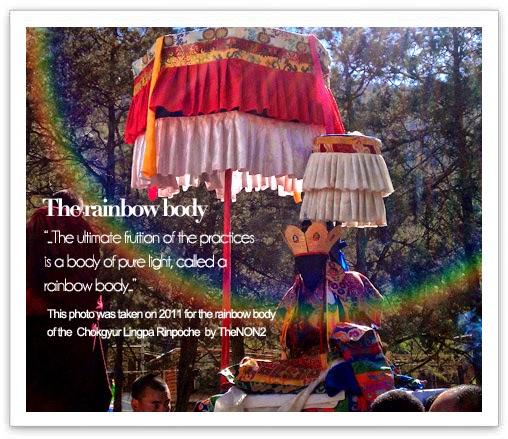


%2Bhandprint%2Bin%2Bsolid%2Brock.jpg)


